Excerpts from Martin Luther King's Where Do We Go From Here: Chaos or Community continued on the issue of the stalling of the civil rights movement in the face of rising white resistance in the mid-1960s:
Meanwhile frustration and a loss of confidence in white power have engendered among many Negroes a response that is essentially a loss of confidence in themselves. They are failing to appreciate two important facts.
First, the line of progress is never straight.... The inevitable counterrevolution that succeeds every period of progress is taking place. Failing to understand that this is a normal process of development, some Negroes are falling into unjustified pessimism and despair. Focusing on the ultimate goal, and discovering it still distant, they declare no progress at all has been made.
This mood illustrates another fact that has been misinterpreted. A final victory is an accumulation of many short-term encounters. To lightly dismiss a success because it does not usher in a complete order of justice is to fail to comprehend the process of achieving ful lvictory. It underestimates the value of confrontation and dissolves the confidence born of a partial victory by which new efforts are empowered.
...
[The Regional Issue]
The struggles of the past decadewere not national in scope; they were southern; they were specifically designed to change life in the South; and the principal role in the North was supportive. It would be a serious error to misconstrue the movement's strategy by measuring northern accomplishments when virtually alll programs were applied in the South and sought remedies applicable solely to it.
...The South was the stronghold of racism. In the white migration s through history from the South to the North and West, racism was carried to poison the rest of the nation. ...
Civil rights leaders had long thought the North would benefit derivatively from the southern struggle. They assumed that without massive upheavals certain systemic changes were inevitable as the whole nation reexamined and searched its conscience. This was a miscalculation. It was founded on the belief that opposition in the North was not intrasigent, that it was flexible and was, if not fully, at least partially hospitable to corrective influences. We forgot what knew daily in the South: freedom is not given, it is won. Concentration of effort in the large northern cities can no longer be postponed in favor of southern campaigns. Both must now be sustained. [emphasis added]
In assessing the results of the Negro revolution so far, it can be concluded that Negroes have established a foothold, no more. We have written a declaration of independence, itself an accomplishment, but the effort to transform the words into a life experience still lies ahead.
The hard truth is that neither Negro nor white has yet done enough to expect the dawn of a new day. While much has been done, it has been accomplished by too few and on a scale too limited for the breadth of the goal: Freedom is not won by a passive acceptance of suffering. Freedom is won in the struggle against suffering. By this measure, Negroes have not yet paid the full price of freedom. And whites have not yet faced the full cost of justice....
No great victories are won in a war for the transformation of a whole people without total participation.... Negroes hold one key to the double lock of peaceful change. The other is in the hands of the white community.
[In recounting the emergence of the Black Power slogan during the Meredith march, King states:]
I guess I should not have been surprised. I should have known that in an atmosphere where false promises are daily realities, where deferred dreams are nightly facts, where acts of unpunished violence toward Negroes are a way of life, nonviolence would eventually be seriously questioned. I should have been reminded that disappointment produces despair and despair produces blindness, and that the one certain thing about bitterness is its blindness. Bitterness has not the capacity to make the distinction between some and all. When some members of the dominant group, particularly those in power, are racist in attitude and practice, bitterness accuses the whole group....
I tried to make it clear that besides opposing violence on principle, I could imagine nothing more impractical and disastrous than for any of us, through misguided judgment, to precipitate a violent confrontation in Mississippi. We had neither the resources nor the techniques to win....
Next the question of the participation of whites was raised. Stokely Carmichael contended that the inclusion of whites in the march should be de-emphasized and that the dominant appeal should be for black participation....
I surmised that much of the change had its psychological roots in the experience of SNCC in Mississippi during the summer of 1964, when a large number of northern white students had come down to help in that racially torn state. What the SNCC workers saw was the most articulate, powerful and self-assured young white people coming to work with the poorest of the Negro people--and simply overwhelming them. That summer Stokely andn others in SNCC had probably unconsciously condcluded that this was no good for Negores, because it simply increased their sense of their own inadequacies. Of course, the answer to this dilemma was not to give up, notto conclude that blacks must work with blacks in order for Negroes to gain a sense of their own meaning. The answer was only to be found in persistent trying, perpetual experimentation, persevering togetherness.
Like life, racial understanding is not something that we find but something that we must create.
...
So Greenwood turned out to be the arena for the birth of the Black Power slogan in the civil rights movement. The phrase had been used long before by Richard Wright andothers, but never until that night had it been used as a slogan in the civil rights movement....
First it is necessary to understand that Black Power is a cry of disappointment. The Black Power slogan did not spring full grown from the head of some philosophical Zeus. It was born from the wounds of despair and disappointment. It is a cry of daily hurt and persistent pain. For centuries the Negro has been caught in the tentacles of white power. Many Negroes have given up faith in the white majority because "white power" with total contral has left them empty-handed. So in reality the call for Black Power is a reaction to the failure of white power.
It is no accident that the birth of this slogan in the civil rights movement took place in Mississippi--the state symbolizing the most blatant abuse of white power. In Mississippi the murder of civil rights workers is still a popular pasttime. In that stare more than forty Negroes and whites have either been lynched or murdered over the last three years, and not a single man has been punished for these crimes. More than fifty Negro churches have been burned or bombed in Mississippi in the last two years, yet the bombers still walk the streets surrounded by the halo of adoration. This is white power in its most brutal, cold-blooded and vicious form.
I wil comment and report excerpts at a later time on King's critique in Where Do We Go From Here? of black power as a slogan and goal. The purpose of this blog was to report the way in which King squarely lays the blame for the rise of the black power slogan and its subsequent domination to the resistance of white society and phenomenally in the intersection of increased white resistance and the point at which the movement had to go to a new stage to seek practical equality and the payments on both sides would be higher and require the participation of all.
Sunday, February 12, 2006


Martin Luther King on the Rise of Black Power and Eclipsing of Nonviolent Direct Action 1
In his book, Where Do We Go From Here: Chaos or Community? Martin Luther King offers an explanation of the Black Power Movement of Stokely Carmichael and others that whites may find surprising. Rather than attacking the Black Power movement, which had begun to eclipse the nonviolent methods of the civil rights movement during the 1965 march for James Meredith, he lays the blame squarely at the stalling of the civil rights movement in the face of rising white resistance. The following are excerpts from Where Do We Go From Here, written in 1967, from the volume A Testament of Hope: The Essential Writings and Speeches of Martin Luther King, Jr., edited by James M. Washington.
One year later [from the 1965 passage of the Voting Rights Act], some of the people who had been brutalized in Selma and who were present at the Capiol ceremonies were leading marchers in the suburbs of Chicago amid a rain of rocks and bottles, among burning automobiles, to the thunder of jeering thousands, many of them waving Nazi flags.
A year later, some of the Negro leaders who had been present in Selma and at the Capitol ceremonies no longer held office in their organizations. They had been discarded to symbolize a radical change in tactics.
A year later, the white backlash had become an emotional electoral issue in California, Maryland, and elsewhere. In several southern state men long regarded as political clowns had become governors or only narrowly missed election, their magic achieved with a witches' brew of bigotry, predudice, half-truths, and whole lies.
During the year, white and Negro civil rights workers had been murdered in several southern communities. The swift and easy acquittals that followed for the accused had shocked much of the nation but sent a wave of unabashed triumph through southern segregationist circles. Many of us wept at the funeral services for the dead and for democracy.
During the year, in several northern and western cities, most tradically in Watts, young Negroes had exploded in violence. In an irrational burst of rage they had sought to say something, but the flames had blackened both themselves and their oppressors.
A year later, Ramparts magazine was asserting, "After more than a decade of the Civil Rights Movement the black American in Harlem, Hanynesville, Baltimore, and Bogalousa is worse off today than he was ten years ago...The Movement is in despair because it has been forced to recognize the Negro revolution as a myth."
Had Negroes fumbled the opportunities described by the president? Was the movement in despair? Why was widespread sympathy with the Negro revolution abruptly submerged in indifference in some quarters or banished by outright hostility in others? Why was there ideological disarray?
A simple explanation holds that Negroes rioted in Watts, the voice of Black Power was heard through the land and the white backlash was born; the public became infuriated and sympathy evaporated. This pat explanation founders, however, on the hard fact that the change in mood had preceded Watts and the Black Power slogan. Moreover, white backlash had always existed underneath and sometimes on the surface of American life. No, the answers are both more complex and, for the long, less pessimistic. [empahsis added]
With Selma and the Voting Rights Act, one phase of development in the civil rights movement came to an end. ...For the vast majority of white Americans, the past decade--the first phase--had been a struggle to treat the Negro with a degree of decency, not of equality. White America was ready to demand that the Negro should be spared the lash of brutality and coarse degradation, but it had never been truly committed to helping him out of poverty, exploitation or all forms of discrimination. The outraged white citizen had been sincere when he snatched the whips from the southern sheriffs and forbade them more cruelties. But when this was a to a degree accomplished, the emotions that had momentarily inflamed him melted away. White Americans left the Negro on the ground and in devastating numbers walked off with the aggressor. ...
When Negroes looked for the second phase, the realization of equality, they found that many of their white allies had quietly disappeared. The Negroes of America had taken the president, the press, and the pulpit at their word when they spoke in broad terms of freedom and justice. But the absence of brutality and unregenerate evil is not the presence of justice. To stay murder is not the same thing as to ordain brotherhood. The word was broken, and the free-running expectations of the Negro crashed into the stone walls of white resistance. The result was havoc. Negroes felt cheated, especially in the North, while many whites felt that the Negroes had gained so much it was virtually impuedent and greedy to ask for more so soon. [emphasis added]
The paths of Negro-white unity that had been converging crossed at Selma, and like a giant X began to diverge. Up to Selma there had been unity to eliminate barbaric conduct. Beyond it the unity had be based on the fulfillment of equality, and in the absence of agreement the paths began inexorably to move apart. [emphasis added]
The practical cost of change up to this pointhas been cheap.... Even more significant changes involved in voter registration required neither large monetary nor psychological sacrifice. Spectaclar and turbulent events that dramatized the demand created an erroneous impression that a heavy burden was involved.
The real cost lies ahead. The stiffening of white resistance is a recognition of that fact. The discount education given Negroes will in the future have to be purchased at full price if quality education is to be realized. Jobs are harder and costlier to create than voting rolls. Te eradication of slums housing millions is complex far beyond integrating buses and lunch counters.
Let us take a look at the size of the problem through the lens of the Negro's status in 1967. When the Constitution was written, a strange formula to determine taxes and representation declared that the Negro was 60 percent of a person. Today another curious formula seems to declare that he is 50 percent of a person. Of the good things in life he has approximately one-half those of whites; of the bad, he has twice those of whites. Thus, half of all Negroes live in substandard housing, and Negros have half the income of whites. When we turn to the negative experiences of life, the Negro has double share. There are twice as many unemployed. The rate of infant mortality (widely accepted as an accurate indexi of general health) among Negroes is double that of whites. The equation pursues Negroes even into war. There were twice as many Negroes as whites in combat in Vietnam at the beginning of 1967, and twice as many Negro soldiers died in action (20.6 percent) in proportion to their numbers in the population....
The great majority of Americans are suspended between these opposing attitudes.[:] They are uneasy with injustice but unwilling yet to pay a significant price to eradicate it.
The persistence of racism in depth and the dawning awareness that Negro demands will necessitate structural changes in society have generated a new phase of white resistance in North and South. Based on the cruel judgement that Negroes have come far enough, there is a strong mood to bring the civil rights movement to a halt or reduce it to a crawl. Negro demands that yesterday evoked admiration and support, today--to many--have become tiresome, unwarranted, and a disturbance to the enjoyment of life. Cries of Black Power and riots are not the causes of white resistance, they are consequences of it. (continued)
Sunday, February 05, 2006
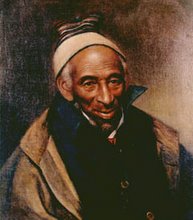
Portrait of Yarrow Mamout by Charles Willson Peale
My ancestor, Charles Willson Peale, painted the beautiful portrait of Yarrow Mamout, that was the subject of an article in the Washington Post Magazine today. See the article at http://www.washingtonpost.com/wp-dyn/content/article/2006/02/03/AR2006020300827.html
The Array Against Civil Rights in the North 1
From Civil Rights The 1960s Freedom Struggle by Rhoda Lois Blumberg, Twayne Publishers, Inc., 1991.
The year after the Watts riots, [Martin Luther] King was invited to Chicago by its black protest leadership. ...[including Jesse Jackson]
On 26 January 1966, King and his family took up temporary residence in Chicago's Lawndale ghetto area. Southern experience would prove to be insufficient preparation for this crucially different northern campaign. ... Demonstrations brought out unexpectedly vicious white mobs that somtimes numbered in the thousands, and black urban dwellers were in a mood to retaliate. Their anger had been recognized and articulated by Malcom X: similar grievances had been given violent expression in the Watts riot. Support could not be expected from the Democratic Administration because of both King's anti-Vietnam stand and Mayor Daley's power in the party. As a big-city boss, Daley knew how to use his power of patronage to buy off key black politicians. (p. 174)
The atmosphere conducive to nonviolent protest had changed... [citing David Levering Lewis, King, A Biography (1978):
"Even if the Vietnam issue had not strained relations to the breaking point, there was virtually no possibility of White House assistance in Chicago. The political power of the Daley machine within the Democratic Party, the socio-economic thrust, as opposed to the former legalistic, of the SCLC's Northern campaign, the complex interrelationships of Eastern finance, Midwestern industry and labor, and federal power--all these constituted built-in restraints upon pro-civil rights intervention by Washington outside the South.... Meanwhile, in Congress legislation was introduced to curtail civil rights demonstrations by Representative Roman Pucinski, an Illinois Democrat and formerly a consistent support of civil rights legislation."
... Civil rights forces felt that 1966 was a crucial year in which they needed to counter the rising black power mood. King focused on housing discrimination in its various forms: exploitative slum housing and de facto segregation created in collusion with real estate interests. ... (p. 175)
As the civil rights forces drew attention to the problems of slum dwellers, Daley countered with his own expressions of concern about the issue. He met with the civil rights delegations, assuring them of good intentions. On the same day, 26 May 1966, that King announced plans for a march on city hall, Daley was able to announce the successful negotiation of a fedeal loan for housing renovation. The significance of the day for civil rights forces was heightened by another tragedy. Jerome Huey, a 17-year-old black youth, was beaten to death on a streetcorner by four white youths in the de facto segregated suburb of Cicero. This was the kind of hateful incident that had galvanized thousands in the South, and the Chicago movement intended to utilize it. ... (p. 176)
1966 became a riot summer in the city. A police-related incident eventuated in a major three-day conflagation. The rivalry between nonviolence and other forms of black revolt was heightening, as was white backlash. The racism of northern white citizens became more overt as they gathered in huge numbers to threaten and jeer nonviolent demonstrators. At an Agusut rally in Marquette Park, King was stunned by a rock thrown at him, and only the police presence held back mobs ready to kill. Racism was virulent in Chicago, but unlike southern officials, Daley and Chicago dignitaries continued to meet with King and his CCCO allies. (page 177)"
The Cicero march took place, in response, but without King's participation... Major concessions had been promised by Mayor "I don't want to buy the black vote, I just want to rent it for a day" Daley. But later Daley backed out of these concessions. Said King: "I look back over it and wish we'd gone to Cicero."
In short, at Cicero, Ill., the civil rights movement met defeat. The attempt to take on the issue of housing--bad housing not fit for human habitation and segregated housing--met with defeat. The liberal New York Times editorialized that Martin Luther King should withdraw from the North; liberal funds dried up for SCLC.
Thursday, January 26, 2006
Memories of the Southern Civil Rights Movement by Danny Lyons
This is a useful, thought-provoking book with the focus on the Student Non-Violent Coordinating Committee (SNCC), since the author was the SNCC staff photographer from 1962 to 1964. It has many photos that I have never seen before, readable copies of typewritten SNCC minutes, and the full uncensored speech of John Lewis before the 1963 March on Washington. The founding, work, and transformation of SNCC from an integrated student organization to one that no longer includes whites in any meaningful sense of the word is an extremely important thread. SNCC was the crucible of the entire shift in the African-American movement nationally. Lyons chronicles the SNCC story in a partially documented but also highly personal way, exposing his own vulnerabilities, thoughts, and doubts. Although the evolution of the organization is not truly illuminated in this book, important pieces of the puzzle are there. SNCC was an organization of courageous individuals--with Diane Nash one of the most courageous and leading others to muster their courage also. Lyons reports that when CORE shut down the freedom rides because of the level of violence perpetrated against them, Nash led SNCC to continue them, despite the danger. Perhaps because James Forman was his own protector within SNCC when agitation (from Marion Barry) began against his position as photographer, Lyons is unabashedly adulatory of Forman, for whom he also served as a "guy Friday." But to my mind, Forman (along with Moses) distinguishes himself in meetings, according to the minutes presented, by separating issues so they don't become a big ball of confusion, setting terms for debate, presenting an overview, or reminding everyone present of the core principles upon which the organization was based. He was also a tireless organizer. Forman was 10 years older than everyone else, and from the get-go evinced (from what Lyons says) a clear conception of how SNCC would garner support through projecting an image into the media and hence the rest of the world. Both he and Moses were school teachers and actual intellectuals--not so-called public intellectuals, but truth-seekers and from the North. Otherwise, Lyons notes, most of those who joined SNCC from the North were white, like him. Very close relationships developed among the core leaders of SNCC, the white leaders such as Bob Zellner, his wife Dottie Miller, Jane Jane Stembridge with the black leaders such as John Lewis, Julian Bond, Bob Moses, and Sam Shirah. All of these leaders were marked with extreme courage. Lyons notes: "That a descendant of the Confederacy [Shirah], a black Alabama farm boy [John Lewis], and a New York Jew were all living together said a great deal about what SNCC was like then."
SNCC was under attack in every battle, offices firebombed, leaders and members and local allies arrested and beaten. As founder Ella Baker, put it: "The whole concept of SNCC was to deal with the hard-core areas," with the idea that if segration could be broken in those areas, it would break everywhere else.
Their relation with SCLC was uneasy, but leaders in SCLC should have been able to see (and I do not know the degree to which they did) that both organizations were necessary and had a role to play. However, by 1964, after very difficult campaigns in Cambridge, Maryland, where Carmichael [apparently from this book] first emerges as a leader, and in Mississippi Summer in 1964, when many students came south for the summer to register voters and create a third party in Mississippi, a fear emerged. It seems that this fear was in part engendered by the fact that money for SNCC, which always ran on a tattered shoestring, had dried up. [Harry Belafonte was--continued to be?--a major funder]. SNCC members started to carry guns or keep guns in their homes, because they were afraid that the office or the place they are staying would be attacked. It is clear that SNCC felt extremely vulnerable. Lyons gives partial minutes of a meeting [the typewritten page] focused on violence. They talk about the need to keep tabs on everyone, because a member could be caught in a threatening situation and no one would know. One week after this meeting, Cheny, Goodman, and Schwerner were killed. These murders had a chilling effect on SNCC and demoralized the leadership. The angry, anti-white Carmichael emerges more and more as a leader, and takes over from Forman, who is also on the verge of total physical collapse. The fear turns to inward-looking paranoia. SNCC did not participate as an organization in Selma, although John Lewis went personally. The SNCC people in the area said that the march was a march toward certain violence, and Lyons notes that it was the last march of the civil rights movement that grew out of the local situation itself. The irony is that SNCC felt this intense pressure from all sides at the point that the movement was actually succeeding in the south.
Nevertheless, after the first Selma battle, Malcolm X was assassinated [he had gone to Selma] and Watts explodes in June[?]. The Carmichael slogan of Black Power overpowered the Meredith march. Lewis left SNCC because he opposed black nationalism. The civil rights movement hit the brick wall of the North, a different ballgame, and liberal support for the movement receded.
Lyons relates parts of the Peg Leg Bates SNCC meeting in December 1966 , in which, after most of the members had gone to bed, a vote was taken that prohibited whites from having any leadership vote or voting rights in the organization. Lyons says it was very unclear what happened at Peg Leg Bates or what the vote was, but it was impossible to overturn--because it is clear this is the current of the situation. By May 1967, SNCC is run by Rapp Brown, and soon it effectively self-dissolves into the Black Panther Party. Other SNCC leaders go their own way, many of them joining the anti-war movement.
The relation between the SCLC and SNCC is very important: the difference in philosophy, approach, and the way in which the victories and/or defeats of one affected the other. The Lewis speech needs to be studied and compared. The commitment of the original SNCC group to nonviolent confrontation--with both terms equally important--was crucial to the civil rights movement. Understanding the change of SNCC in detail is extremely important to understanding the problems of today.
Tuesday, January 24, 2006
Of Course....
One purpose of this blog is to encourage those who might come across it to read any of the books below, all of which are worthwhile and interesting, and any of the books or articles that are discussed on out.
Assumptions to be Tested
The assumptions are the following:
1. There is a racial problem in the United States that affects African-Americas uniquely, because of the unique experience of slavery. This problem was lessened but not solved by the civil rights movement and its achievements. This problem will not be solved by a continuation or increase of methods used since the era of Lyndon Johnson. This problem continues to impose suffering upon African-Americans, but it is not simply a problem of poverty that can be solved by throwing money at it.
2. White people in the United States are generally oblivious to this problem, unless directly confronted with images of it. They believe that slavery is over, civil rights have been won, and that is it. Unless an African-American acts like a middle-class American, they have no understanding of African-Americans and as likely as not, will find themselves surprised by statements from middle-class African-Americans as well.
3. African-Americans have a pscyhological burden still upon them from the days of slavery and its terrible degradation of African-Americans; little that has happened since 1863 has lifted that burden. In my view, whereas Martin Luther King tried to lift it, the combination of the defeat of the civil rights movement in Chicago and the rise of the Black Power movement, acted to put many African-Americans back in the box. However, while African-Americans suffer from this burden, African-Americans did not cause it and cannot lift it alone.
4. It is important to note and to explore the implications of the fact that the civil rights movement was defeated in the north, not in the south, and when King came to the north, the liberal establishment discontinued its support to the civil rights movement.
5. The extreme segregation in the north, which has largely been left untouched, has created a wall of fear between whites and blacks in this region. This wall is thickened by the fact that compared with the south, where at least whites and black knew each other even if they hated each other most of the time, in the north, there is little if any social interaction between the races.
6. The racial problem in the United States is a probem for all Americans, not just African-Americans, beyond Martin Luther King's declaration that denial of rights to black citizens was a threat to all Americans. The reason that I am trying to get to is discusssed by Ralph Ellison briefly in his 1945 essay, "Beating That Boy," as follows:
"For since 1876 [formal imposition of Jim Crow], the race issue has been like a stave driven in to the American system of values, a stave so deeply imbedded in the American ethos as to render America a nation of ethical schizophrenics. Believing truly in democracy on one side of their minds, they act on the other in violation of its most sacred principles; holding that all men are created equal, they treat 13 million Americans as though they were not.... In terms of the ethical and pscyhological, what was opportunistically labeled 'the Negro problem' is actually a guilt problem charged with pain....
"This unwillingness to resolve the conflict in keeping with the democratic ideas has compelled the white American figuratively to force the Negro down into the deeper level of his consciousness, into the inner world, where reason and madness mingle with hope and memory and endlessly give birth to nightmare and dream....
"Indeed, the racial situation has exerted an influence upon the writer similar to that of an X-ray concealed in a radio. Moving about, perhaps ignoring, perhaps enjoying Jack Benny and Rochester, or a hot jazz band, he is unaware of his exposure to a force that shrivels his vital sperm. Not that it has rendered him completely sterile, but that it has caused him to produce deformed progeny--literary offspring without hearts, without brains, viscera or vision, and some even without genitalia.
"Thus it has not been the failure to depict racial matters that has determined the quality of American writing, but that the writer has formed the habit of living and thinking in a culture that is opposed to the deep thought and feeling necessary to profound art; hence its avoidance of emotion, its fear of ideas, its obsession with mere physical violence and pain, its overemphasis of understatement, its precise and complex verbal contructions for coverting goatsong ito carefully undulated squeaks."
Although I cannot articulate it, I feel that what Ellison is saying is true. The wound is open within the African-American community, and buried but alive within the white community (signs of which will be discussed later). How to heal it?
The Books So Far
Since I wrote the first blog in early September about Katrina, I have read the following books:
Their Eyes Were Watching God, by Zora Neale Hurston
Articles, by Zora Neale Hurston
The Sanctified Church, by Zora Neale Hurston
The Bluest Eye, by Toni Morrison
Zora Neale Hurston: A Life in Letters, by Carla Kaplan, ed.
Dust Tracks in the Road, by Zora Neale Hurston
The House Behind the Cedars, by Charles Chesnutt
The Anatomy of Racial Inequality, by Glenn C. Lowry
Sula, by Toni Morrison
In My Father's House, by Ernest J. Gaines
A Million Black Voices, by Richard Wright
"Fire and Cloud" and "The Long Black Song," by Richard Wright
Bloodline, by Ernest J. Gaines
In Search of Our Mother's Garden, by Alice Walker
Ralph Ellison, The Collected Essays.
A Lesson Before Dying, by Ernest J. Gaines
The Autobiography of Miss Jane Pittman, by Ernest J. Gaines
Nobody Knows My Name, by James Baldwin
Notes of a Native Son, by James Baldwin
Blues Dancing, by Dianna McKinney Whetstone
The Wedding, by Dorothy West
The Livin' Is Easy, by Dorothy West
Always Outnumbered, Always Outgunned, by Walter Mosley
The Richer, the Poorer, by Dorothy West
Gone Fishing, by Walter Mosley
The Street, by Ann Petry
The Man in My Basement, by Walter Mosley
Black Betty (partial), by Walter Mosley
The Fire Next Time, by James Baldwin
The Souls of Black Folk by W.E.B. DuBois
As I look at this list, I see it covers a wide variety. The book I loved the most was Their Eyes Were Watching God. I also loved all the stories in Bloodline by Ernest J. Gaines. I admired very much the other books that I read of his. I found The Anatomy of Racial Inequality to be very insightful and thought-provoking. I also much admired Always Outnumbered, Always Outgunned, by Walter Mosley.
I found James Baldwin to be the most painfully honest of all. I am not surprised that he or other African-American male writers feel compelled to leave the country and probably leave it in order to continue writing. The essays of Ralph Ellison were among the first books I read, and I learned a lot from them. However, compared with Baldwin, he seems to be one step removed from what he is writing about--as if he is a very astute observer. Either he has filtered life, or he is writing to a different audience or has a different relation to his audience than has Baldwin.
In general, and I will detail this later, I found the women writers to be disappointing. The Bluest Eye by Toni Morrison, I believe to be her first book, is an audacious book and a profound study of psychological disintegration. I was astonished by it. However, I positively disliked Sula, and am not sure what she is trying to say (have to read commentaries on it), and I had read Beloved previously and found it somewhat disturbing. She seems to be obsessed with death rather than with life and with women who murder their children. In direct contrast to her, it seems to me, are the books of Ernest J. Gaines. I am happy that his A Lesson Before Dying is required reading in many high schools, but I did not find this to be his best work. I found the message in his books to be blunt and to the point, but because the stories are written in such a simple and unegotistical way, one does not bristle in reaction to any didacticism in his books. I went to hear him read and answer questions at a bookstore, and the man is exactly as he seems: good, humble, and noble. He says he writes books about characters that he hopes will improve the characters of the readers--such an old-fashioned idea (it would seem in today's cultural environment), but everyone is starving for it.
There are many more books that I must read. I find that white people do not often write nonfiction about race unless they are aggressive racists. James Reston has written a book on the tragedy of the failure of integration. There are other books in the library by white writers on race or perceptions of race. Few white writers tackle problems.
We are thankful for William Faulkner and Carson McCullers. It must be so enraging to African-Americans that Faulkner could so poignantly and beautifully portray the manhood and humanity of African-Americans (especially in Go Down, Moses), but then hold views that were opposed to civil rights. However, it is impossible to ignore his portrayals. Carson McCullers' portrayal in The Heart Is a Lonely Hunter is astounding.
Very rarely, except in Intruder in the Dust, for example, or To Kill a Mockingbird, do we see portrayals of white people trying to deal with the problems of the racial injustice and enforced degradation.
Many books display very open and harsh anger towards all whites in general, with perhaps exceptions noted. More on this later.
Monday, January 23, 2006
Following from Katrina 2
This blog will be a posting of thoughts upon readings since Katrina on racial relations in the United States between primarily the white majority and African-Americans. It will not follow the view that African-Americans should be lumped in with Latinos and any other "minority" into a rainbow coalition a la the Democratic Party, but is premised on the fact that the African-American experience is unique in the United States and must be addressed as such.
Beginning with Katrina...
am sickened to my very core over what has happened to New Orleans and the implications of this for our country:1. That again, it is the poorest and most vulnerable people in our country who are the hardest hit and are forced to undergo unimaginable suffering. Who can erase these images of suffering in New Orleans from their heart's eye?2. That all levels of government failed, before, during, and after the storm and the flooding that resulted.3. That instead of concentrating on how to unite and pull together to solve the huge problems in our country that Hurricane Katrina has so glaringly exposed, we have indulged in "finger-pointing," self-righteous indignation, threats of violence to an American President from a senator, and on the part of the media, constant obfuscation of the truth. In short, that the jacobin cry of "heads must roll" has replaced common sense.Common sense says that this storm overpowered everyone.It holds up a horrifying mirror to ourselves—all of us.Hurricane Katrina exposed that we have not even begun to solve the killing marginalization of the poorest and most vulnerable in our country.It exposed that we have shortchanged our investment in the nation’s infrastructure to the point of murder, and, on the other hand, in our profit-driven zeal to rearrange nature in any way that suits us, we have wreaked havoc with the environment to such a point that nature’s revenge was all but inevitable.It exposed that our culture is driven by unfounded expectations of instant gratification, instant weight-loss, instant money, instant solutions—instant relief and evacuation, instant law and order in a city plunged into desperation.Can we realistically expect the federal government or any state or local government or combination thereof to make up for the accumulated effect of decades of neglect and failure to consider consequences—in the space of one week in the face of the country’s worse natural disaster this country.We must hope that enough of our citizens are not swept away by either apathy or by partisan pummeling, such that we do not, as a nation, look deeply into ourselves and at the society we have created and ask how we can take responsibility for our country's future.
Subscribe to:
Posts (Atom)